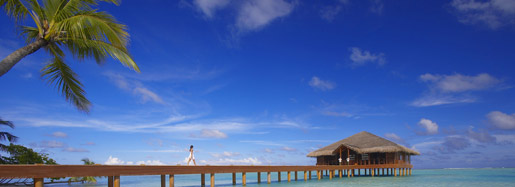
Specks of emerald green enveloped by dazzling turquoise waters like scattered beads in the ocean; white powdery beaches, tall palms lean on towards the sea, crystalline white sands giving way to crystal clear waters, shades of turquoise blend flawlessly with deeper hues of blue; pristine coral reefs and some of the most incredible underwater life on our planet.
Rising from the deep blue of the vast expanse of the Indian Ocean are more than a thousand islands and thousands more reefs that form the Maldives.
The Maldives Islands comprises of roughly 1190 small coral islands, and covers a total area of 104,00.00 sq. Kilometers. These islands are no more than six feet above sea level and lie 73 degrees East Equator. The islands are grouped into nineteen administrative ‘atolls’, and vary in size and character. Some are sandbanks, while others are tropical islands, with lush vegetation, ringed with coral reefs, turquoise lagoons full of marine life, and white sandy beaches.
Maldives at a Glance
Time: + 5 hrs GMT
Capital: Malé
Total number of islands: 1,190
Inhabited Islands: 2002
Population: 400,000
Major Industries: Tourism & Fisheries
Resorts: 100+
Currency: Rufiyaa (All major currencies, credit cards and travelers cheques accepted)
Transport: Speedboats, Dhoni, Seaplanes and Domestic flights
Working days: Sunday to Thursday
Location
The Maldives consists of 1190 islands grouped into 26 natural atolls scattered over an area of 90,000 sq. km straddling the equator between,
– Degree of latitudes 07° 6’30” North and 00°41’48” South – Degree of longitudes 72° 32’30” and 73° 45’54” East.
Maldives Geography
The atolls of the Maldives are formed from coral structures. The atolls are part of a greater structure known as the Laccadives-Chagos Ridge, which stretches over 2000 kilometers. The Maldives islands are low lying with the highest point at approximately eight feet above sea level. Ring-shaped reef structures form the atolls and these reefs provide the natural defense against wind and wave action on these delicate islands.
Culture
Located at the cross-ways of the Indian Ocean shipping lanes on the main seaway around the Indian subcontinent, the Maldives has long been a meeting point for African, Arab, Malay and Indonesian mariners.
Throughout the centuries these influences have shaped the Maldivian way of life. This can be seen from the many facets of Maldivian lifestyle such as dining, music, art and craft.
Music
Bodu Beru is the most popular form of music and dance in the country, believed to have been introduced in the early 19th century by African slaves. Historians believe that Thaara, which also holds a special place in local entertainment, have been introduced from the Middle East in the seventeenth century.
Other forms of dance such as Bandiya Jehun have a strong South Asian flavor. Today western pop and Indian music is popular with the young and old.
Art & Craft
The Maldivians are skilled craftsmen. This can be seen in several of Maldivian arts and craft; the deft coral stone carvings at Hukuru Miskiiy, the intricate lacquer art, the fine mats woven by the women of Fioari in the south and the work of skilled calligraphers whose works old and new that can be viewed in mosques around the country.
Maldives FAQ
What is Maldives and where is it located?
The Maldives is a tropical country with beautiful beaches, glistening waters, and stunning coral reefs. Maldives is located southwest of Sri Lanka and India in the Indian Ocean.
How do I get to the Maldives?
The majority of visitors to the Maldives arrive by plane, and Malé International Airport is where they land. Visitors can then travel by ferry, speedboat or domestic flight to their resort or hotel.
The Maldives have a tropical climate with two distinct seasons—the dry season (November to April) and the wet season (May to October)—and warm temperatures all year long. The usual range of temperatures is 25–30°C (77–86°F).
What is the best time to visit the Maldives?
The dry season, which lasts from November to April, is the ideal time to visit the Maldives. Visitors can take advantage of the clear skies, calm seas, and abundance of opportunities for outdoor recreation and water sports during this time.
What are the Maldives’ visa and entry requirements?
Most visitors are given a 30-day visa at the airport.
A current passport and a return ticket are required and visitors must have proof of lodging and enough money to cover their expenses.
However, before making travel arrangements to the Maldives, it is crucial to confirm the most recent visa requirements and travel warnings.
What are the top tourist attractions in the Maldives?
The Maldives is a well-liked location for snorkeling and scuba diving because of its stunning beaches and coral reefs. The Maldives National Museum, Grand Friday Mosque, and Maldives Fish Market are a few more well-liked sights.
What is the currency used in the Maldives?
The Maldivian rufiyaa is the local currency in the Maldives. Many resorts and hotels also accept major credit cards, and US dollars are widely accepted.
What languages are spoken in the Maldives?
English is widely used in tourist areas despite Dhivehi being the official language of the Maldives.
What is the cuisine like in the Maldives?
The Maldives’ geographic setting and closeness to the ocean have a significant impact on the cuisine there. Maldivian cuisine frequently features seafood, and popular dishes include grilled fish, fish curries, and fish soup (garudhiya). Along with rice and flatbreads (roshi), coconut is another common ingredient in food.
Mas Huni (a breakfast dish made with shredded tuna, coconut, and chili) are all well-liked dishes.
What is the culture of the Maldives like?
The location and history of the Maldives have influenced the rich and varied culture there. Visitors should respect local customs and traditions because the majority of the population is Muslim. Maldivian culture also places a lot of emphasis on traditional music, dance, and visual arts.
What types of accommodation are available in the Maldives?
A variety of lodging choices are available in the Maldives, ranging from affordable guesthouses to opulent resorts and overwater villas. Depending on their preferences and budget, visitors can select from beachfront bungalows, water villas, and private island resorts.
Can I travel to the Maldives with children?
Yes, the Maldives is a family-friendly vacation spot with lots of resorts and lodging options that provide amenities and activities for kids.
What is the most unique experience to have in the Maldives?
With breathtaking ocean views and immediate access to the water, staying in an overwater villa is a one-of-a-kind and unforgettable experience in the Maldives. Visitors can also participate in a program for coral reef conservation or take a sunset cruise on a traditional Maldivian boat.
What are the transportation options in the Maldives?
The main modes of transportation in the Maldives are boats, ferry and seaplanes. In order to get to their resort or island destination, visitors can take a domestic flight or a speedboat.
Usually, resorts and hotels provide transportation to and from the airport.
Is it safe to visit the Maldives?
With little crime and a welcoming local populace, the Maldives is a secure tourist destination. Visitors should observe common safety precautions to protect their property and be respectful of cultural traditions.
What is the diving like in the Maldives?
With over a thousand different fish species and a wide variety of marine life, the Maldives are well known for their diving opportunities. Divers can see manta rays, whale sharks, and vibrant coral reefs at the North Male Atoll, Ari Atoll, and Vaavu Atoll, three of the most well-liked dive sites.
What are the top water sports activities in the Maldives?
Water sports enthusiasts will find paradise in the Maldives, where stand-up paddleboarding, surfing, scuba diving, and snorkeling are all very popular. Also available to visitors are fishing excursions and sunset cruises on traditional Maldivian boats.
What is the best way to explore the Maldives?
The best way to see the Maldives is by boat, whether it’s a luxury yacht or a traditional Maldivian boat. The marine life can be explored by snorkeling or diving, island hopping, or taking a sunset cruise.
What is the best way to experience the local culture in the Maldives?
In the Maldives, tourists can get a taste of the local way of life by visiting nearby villages, going to traditional music and dance performances, and eating local food. Additionally, a lot of resorts provide cultural events like workshops for making handicrafts, cultural tours, and cooking classes in the Maldives.
What are some popular water sports to try in the Maldives?
Water sports like windsurfing, kayaking, scuba diving, and snorkeling are available in the Maldives. Additionally available to visitors are stand-up paddle-boarding, jet skiing, and parasailing.
What is the nightlife like in the Maldives?
The Maldives is primarily a vacation spot for relaxation and outdoor activities, so it is not well known for its nightlife. However, some resorts host beach parties, live music events, and cultural performances in the evening.
Can I drink alcohol in the Maldives?
Only resorts and hotels that cater to tourists sell alcohol. Alcohol importation and public consumption outside of designated areas are both prohibited.
Are there any cultural traditions that visitors to the Maldives should be aware of?
Visitors to the Maldives should respect local traditions and customs, such as dress codes, prayer hours, and prohibitions on alcohol. Because the Maldives is a Muslim nation, visitors should wear modest clothing when out in public.
What are some cultural festivals and events in the Maldives?
The Maldives observes a number of cultural holidays throughout the year, such as National Day, Eid al-Fitr, and Eid al-Adha. Cultural events like traditional music and dance performances, art exhibits, and food festivals are available to visitors as well.
What shopping options are available in the Maldives?
The Maldives are well known for their handicrafts, which include traditional lacquerware, woven mats, and items made of coir rope. Local markets and gift shops offer a variety of souvenirs, apparel, and jewelry to tourists.
What is the dress code in the Maldives?
Since the Maldives is a Muslim nation, visitors are advised to wear modest clothing when in public spaces. Beachwear is acceptable at resorts and on the sand, but tourists are required to cover up when they enter local mosques and villages.